


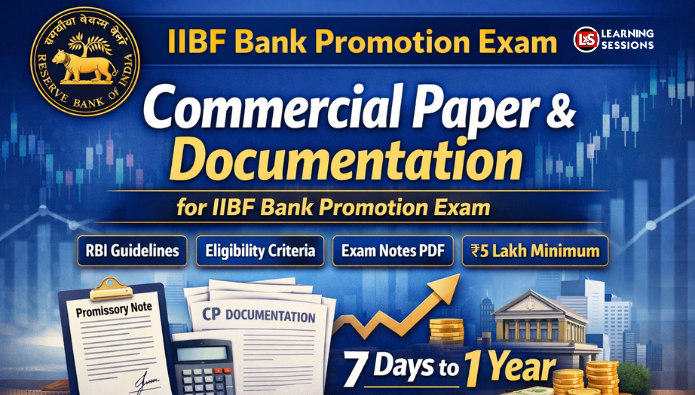
Commercial Paper (CP) is one of the most important money market instruments frequently asked in IIBF Bank Promotion Exams. It is a short-term unsecured borrowing instrument used by corporates and financial institutions to meet working capital requirements in an efficient and cost-effective manner.
WATCH FULL VIDEO:
1. Meaning and Definition of Commercial Paper
Commercial Paper is a short-term unsecured promissory note issued in dematerialized form
by eligible corporates, financial institutions, and primary dealers with a maturity ranging from
7 days to 1 year, as per RBI guidelines.
It is called unsecured because the issuer does not provide any collateral security against the borrowing.
Therefore, only financially sound entities with strong credit ratings are normally allowed to issue it.
2. Historical Background
Commercial Paper was introduced in India in 1990 on the recommendation of the
Vaghul Committee. The purpose was to widen the money market, reduce excessive dependence
on bank finance, and provide an alternative short-term financing source to eligible corporates.
3. Key Features of Commercial Paper
| Feature | Explanation |
|---|---|
| Nature | Unsecured instrument |
| Instrument Type | Promissory Note |
| Form | Dematerialized form only |
| Issue Method | Issued at discount to face value |
| Redemption | Redeemed at face value on maturity |
| Transferability | Freely transferable |
| Regulation | Governed by RBI guidelines |
4. Maturity, Minimum Investment, and Threshold Limits
| Parameter | Limit / Threshold |
|---|---|
| Minimum Tenure | 7 days |
| Maximum Tenure | 1 year (365 days) |
| Minimum Investment | ₹5 lakh |
| Minimum Issue Size | ₹5 lakh |
| Investment Multiples | In multiples of ₹5 lakh |
5. Eligible Issuers of Commercial Paper
Following entities are generally eligible to issue Commercial Paper:
- Corporates
- Primary Dealers (PDs)
- Financial Institutions (FIs)
6. Eligibility Criteria for Issuers
| Criteria | Requirement |
|---|---|
| Net Worth | Positive net worth |
| Credit Rating | Minimum A3 rating or equivalent |
| Banking Arrangement | Working capital limit sanctioned by bank / financial institution |
| Account Status | Standard Asset |
| Default Status | No recent default in repayment obligations |
7. Who Can Invest in Commercial Paper?
Commercial Paper can be subscribed by a wide range of investors, including:
- Banks
- Mutual Funds
- Corporates
- NBFCs
- Individuals, especially high net worth investors
8. Purpose of Commercial Paper
Commercial Paper is used primarily for short-term financing needs. Its major purposes include:
- Meeting working capital requirements
- Managing short-term liquidity gaps
- Bridge financing until long-term funds become available
- Seasonal funding requirements in business cycles
- Reducing dependence on traditional bank borrowings
9. Advantages of Commercial Paper
For Issuers
- Lower cost of borrowing compared to bank finance in many cases
- No collateral security required
- Flexible tenure within the permitted limit
- Fast access to short-term funds for highly rated entities
For Investors
- Better return compared to many traditional short-term avenues
- Useful short-term investment option
- Freely transferable instrument
10. Limitations and Risks of Commercial Paper
For Issuers
- Only strong and well-rated entities can access CP market effectively
- Market conditions affect pricing and investor appetite
- Refinancing risk may arise at maturity
For Investors
- Credit Risk: Since CP is unsecured, default risk exists
- Liquidity Risk: Secondary market liquidity may not always be deep
- Interest Rate Risk: Market rate movements can affect investment attractiveness
11. Types of Commercial Paper
Though Commercial Paper is a standardized instrument, from a practical and conceptual perspective,
it can be understood in different use-based categories:
| Type | Meaning |
|---|---|
| Working Capital CP | Issued for day-to-day operational funding needs |
| Bridge Financing CP | Issued for temporary funding until long-term finance is arranged |
| Seasonal CP | Issued for seasonal requirements in specific industries |
12. Process of Issuance of Commercial Paper
- Issuer obtains the required credit rating
- Board Resolution is passed authorizing the issue
- A bank is appointed as Issuing and Paying Agent (IPA)
- Necessary documentation is prepared and verified
- Commercial Paper is issued in demat form
- Investors subscribe to the instrument
- Redemption takes place at face value on maturity date
13. Documentation in Commercial Paper
Documentation is one of the most important areas from the IIBF examination perspective.
Questions are often asked on the legal nature of CP, mandatory documents, and the role of the bank.
13.1 Promissory Note
Commercial Paper is issued in the form of a Promissory Note under the
Negotiable Instruments Act, 1881.
A valid Promissory Note must include:
- An unconditional promise to pay
- A definite and specified amount
- Name of payee or holder
- Maturity date
- Signature of authorized signatory
13.2 Board Resolution
The issuing company must pass a Board Resolution authorizing:
- Total amount of CP to be issued
- Tenure of issue
- Authorized signatories
- Appointment of Issuing and Paying Agent
13.3 Credit Rating Certificate
A valid credit rating certificate is mandatory. The minimum rating threshold is
A3 or equivalent.
13.4 Issuing and Paying Agent (IPA) Agreement
The issuer must appoint a scheduled bank as an Issuing and Paying Agent.
The IPA verifies compliance, documentation, and eligibility conditions before the issue is processed.
13.5 Offer Document / Information Memorandum
This document generally contains:
- Company profile
- Financial performance details
- Risk disclosures
- Issue size and tenure details
- Terms of issue
Goods and Services Tax | Complete GST for Bankers + Video Lecture
13.6 Demat Arrangement
Commercial Paper must be issued in dematerialized form only.
Depository arrangements are typically made through NSDL or CDSL.
13.7 Auditor’s Certificate
The statutory auditor may certify:
- Financial soundness of issuer
- Compliance with applicable norms
- No default position, where required
14. Role of Issuing and Paying Agent (IPA)
The bank acting as IPA performs a very important operational and compliance role.
| Responsibility | Explanation |
|---|---|
| Eligibility Verification | Checks whether issuer meets all norms |
| Documentation Review | Ensures required documents are complete and valid |
| Compliance Check | Verifies adherence to RBI guidelines |
| Issuance Facilitation | Supports issue process and settlement arrangements |
| Redemption | Handles payment obligations on maturity |
15. RBI Guidelines – Important Exam Points
| Parameter | Rule / Threshold |
|---|---|
| Issuance Form | Demat form only |
| Minimum Maturity | 7 days |
| Maximum Maturity | 1 year |
| Minimum Rating | A3 or equivalent |
| Minimum Investment | ₹5 lakh |
| Issue Price | Normally issued at discount |
| IPA | Mandatory |
| Default Reporting | Mandatory as per regulatory requirements |
16. Pricing of Commercial Paper
Commercial Paper is generally issued at a discount and redeemed at face value.
The difference between face value and issue price represents the return to the investor.
Discount = Face Value – Issue Price
| Particular | Amount |
|---|---|
| Face Value | ₹10,00,000 |
| Issue Price | ₹9,60,000 |
| Investor Gain | ₹40,000 |
17. Practical Example for Exam Understanding
Suppose a company issues Commercial Paper of ₹1 crore for
90 days at an issue price of ₹96 lakh.
On maturity, the investor receives the full face value of ₹1 crore.
Therefore, the gain earned by the investor is:
Gain = ₹1,00,00,000 – ₹96,00,000 = ₹4,00,000
18. Commercial Paper vs Bank Loan
| Basis | Commercial Paper | Bank Loan |
|---|---|---|
| Security | Unsecured | Usually secured |
| Cost | Often lower for highly rated issuers | Can be higher |
| Flexibility | High within short-term framework | Depends on sanction terms |
| Access | Restricted to strong issuers | Relatively wider |
19. Commercial Paper vs Certificate of Deposit
| Basis | Commercial Paper | Certificate of Deposit |
|---|---|---|
| Issuer | Corporates, FIs, PDs | Banks / Financial Institutions |
| Nature | Unsecured | Money market deposit instrument |
| Risk Level | Generally higher | Generally lower than CP |
| Use | Short-term borrowing by issuers | Mobilization of short-term funds by banks |
20. Important Risks Associated with Commercial Paper
Credit Risk
Since Commercial Paper is unsecured, the investor depends entirely on the creditworthiness of the issuer.
Liquidity Risk
Though CP is transferable, a liquid secondary market may not always be available at the desired price.
Interest Rate Risk
Changes in short-term interest rates may affect the market attractiveness and yield expectations of CP.
21. Important Exam-Oriented Points to Remember
- Commercial Paper is an unsecured instrument
- It is issued in the form of a Promissory Note
- Minimum maturity is 7 days
- Maximum maturity is 1 year
- Minimum credit rating required is A3
- Minimum investment threshold is ₹5 lakh
- CP must be issued in demat form only
- A bank acts as the Issuing and Paying Agent (IPA)
22. Common IIBF Question Areas
In IIBF Bank Promotion exams, questions are commonly asked on:
- Definition and features of Commercial Paper
- Minimum and maximum maturity limits
- Minimum investment and issue threshold
- Role of IPA
- Minimum rating requirement
- Documentation involved in CP issuance
- Comparison with other money market instruments
Quick Revision Summary Table
| Topic | Key Point |
|---|---|
| Nature | Unsecured |
| Instrument | Promissory Note |
| Minimum Tenure | 7 days |
| Maximum Tenure | 1 year |
| Minimum Investment | ₹5 lakh |
| Minimum Rating | A3 |
| Form | Demat only |
| Issuer | Corporates, Financial Institutions, Primary Dealers |
| Bank’s Role | Issuing and Paying Agent (IPA) |
Conclusion
Commercial Paper is a very important short-term money market instrument and an equally important topic for IIBF Bank Promotion examinations. A strong understanding of its meaning, features, documentation, regulatory framework, threshold limits, and practical use is essential for both exam success and banking knowledge enhancement.
Also Like:


, documentation, examples, and notes for exam preparation.)